Several years ago, I came across a study from an amazing Australian psychologist, Dr. Brian Costello. While undergoing treatment for cancer, he discovered that he could reduce his need for pain medication by focusing on a fluorescent yellow-green colored dot.
In his research, he learned that it was not only the benefit of focusing and quiet time, as in meditation, but also the specific frequency from the resultant afterimage (in this case in the violet spectrum). An afterimage is the secondary color that is seen against the white background when viewing the fluorescent yellow-green image.
The yellow-green dot actually caused the brain to produce alpha brainwaves. When alpha brainwaves are produced, one experiences a heightened sense of relaxation and pleasure, thus his pain relief.
I was skeptical at first, but made up a fluorescent yellow-green dot and began practicing. For six days straight, I used the disk for about 15 minutes, two times a day. Six days into it, something happened, I felt something very different.
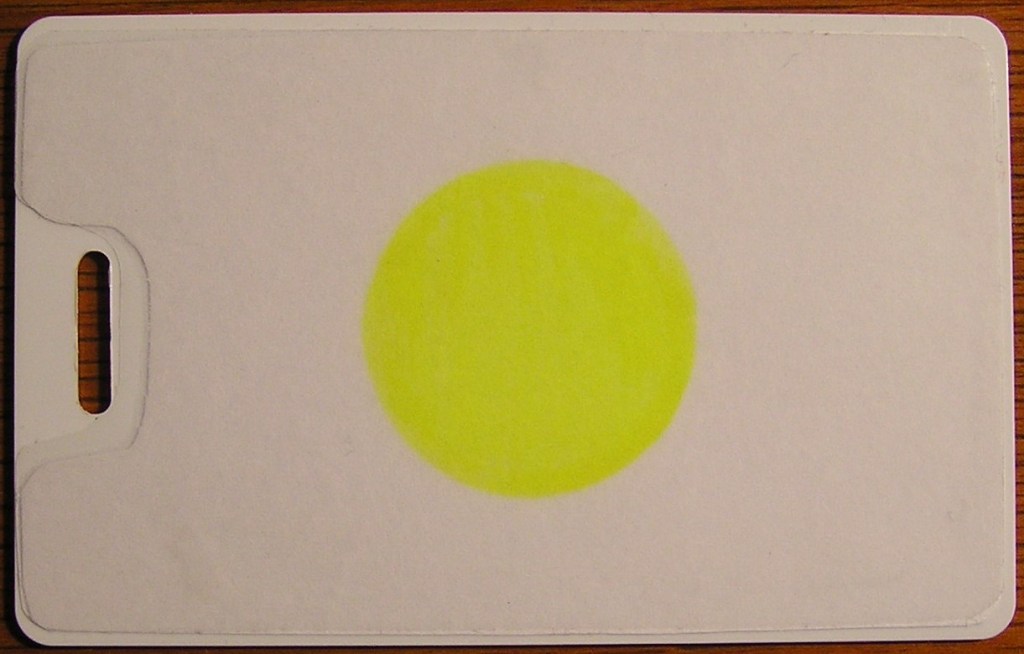
I began to feel a warm sensation in my legs, and then it moved to the base of my spine, up into my chest and into my head. It felt so amazing that I remember thinking “is this legal?” The sensation lasted for several minutes. I felt immense pleasure and relaxation. This crazy idea really works!
My brother said that my ‘kundalini’ had been awakened. I think that the two hemispheres of my brain were at the same alpha frequency – in other words, I was producing pure alpha brainwaves.
I had recently completed a week-long boot camp in sports psychology, and thought that this concept would do well to relax athletes prior to performing.
After some trial and error, I designed and packaged an Alpha Disk, specifically designed for golfers, but could be used by anyone to relax and improve any performance: sports, taking a test, dancing, or musical performances for example. In short, if stress is reduced improvement takes place.
Below is the AlphaWAVE Disk. I called the package “Fry One On.” As when someone hits a ball hard, they ‘smoke or sizzle’ it. Plus, it looked like a fried egg!
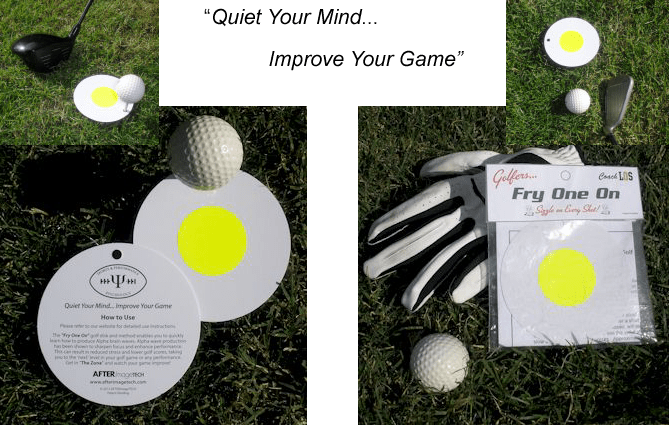
The package included two disks, two smaller disks and instructions.
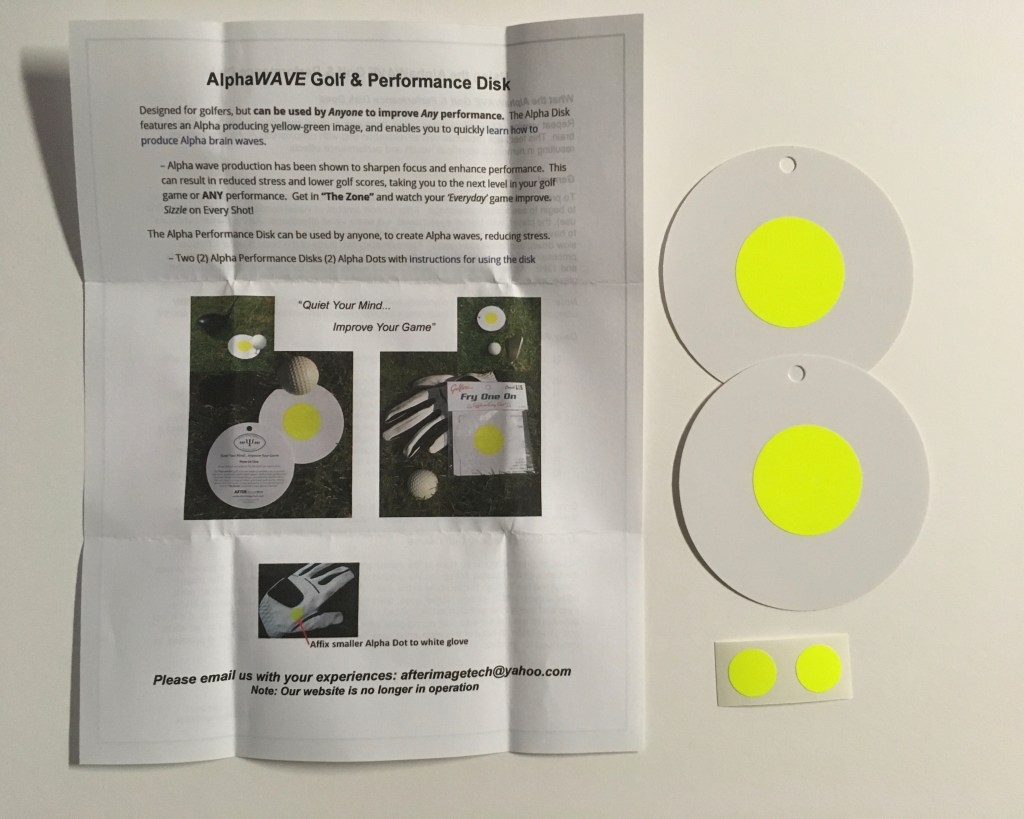
The smaller dots can be placed on gloves, rackets, bats, etc., as a quick reminder to relax and recover when under performance pressure.
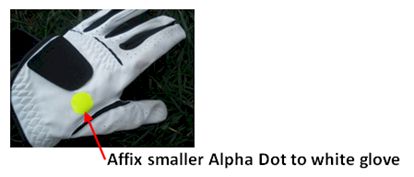
An independent pilot study, commissioned by Adidas, found that the intervention group shooting basketball free throws improved by 4.4% over the control group. It really works!
So this really works, then how come I can’t sell these? Well, apparently no one wants to spend 15 minutes a day over six days to learn how to produce alpha brainwaves.
Most humans just want to ‘pop’ a pill to feel or perform better – too bad!
Maybe my idea just isn’t ready to hatch yet.


 Mr. G's Mind