Cataracts: Energy and Mental Health

A few years ago, I experienced Blog Burnout – why? I was just not interested in writing anymore. In fact, I was not really interested in doing much of anything.

I knew that aging and life changes had affected my energy levels and mental well being. But why? I’d experienced other life changes, and sure, it affected me for a while, but not for months at a time. Something else was going on.

One change, was my vision. My visual acuity had greatly diminished. I had worn glasses for most of my life, but now even new glasses did not improve my vision like they once did. I could still see well enough to read and write, and do other activities, so why wasn’t I doing them?

It wasn’t until I had cataract surgery in both eyes, that I realized the answer.

A cataract is the crystallization or hardening of the internal lens of the eye. The normally clear lens, in conjunction with the cornea, refracts or bends light, allowing it to focus sharply onto the macula area of the retina. The crystallization of the lens makes the lens cloudy, preventing proper focusing, and reduces the amount of light entering the eye, resulting in diminished visual acuity.
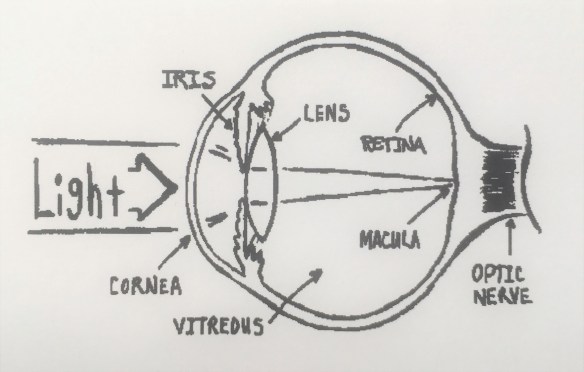
During cataract surgery the old lens is removed, and a new Intraocular Lens (IOL) is put in its place. The IOL enables proper focusing, and allows the maximum amount of light to enter the eye, restoring clear vision. An individual, may still need external eye wear depending on other eye issues, but generally speaking the results are amazing!

In my case, my vision was restored to nearly perfect or 20/20 vision, as I am sure you’ve heard it called. Mine was actually 20/25 combined vision for both eyes!

So my surgery result was great, and of course I was very pleased, but my energy level still had not improved.

About six months after the surgery, I found myself doing projects. A lot of projects! Blogging, songwriting, household projects, planning outings, etc. It was like suddenly I had a burst of energy. I was elated by this energy, but I wondered why?

Then I recalled an article I had read decades before. It was by Dr. John Ott on Full Spectrum Light (FSL). Dr. Ott found that plant, animal, and human health all improve when exposed to FSL – or the full range of the sun’s visible colors, including wavelengths like infrared.

When one stays indoors, is continuously exposed to artificial lighting, or experiences long dark winters with reduced sunlight, they lose energy or become depressed. In my case, my dense cataracts were preventing me from getting FSL, thus my low energy and moody well being. That had to be it!

What does FSL do to the brain? Individuals who experience Seasonal Affective Disorder (SAD) during the fall and winter months when sunlight is diminished, produce lower levels of the hormone serotonin.

“Serotonin is known to reduce depression and regulate mood, which in turn affects energy levels.”

There you have it. My cataracts prevented FSL from entering my eye, thus affecting my serotonin production!

Cataracts removed, my body took a while to adapt, and six months later my serotonin levels increased to normal and so did my life! That’s my theory anyway.

FSL is actually available in films and lighting equipment for those long, dark winter months. It should be utilized in schools, hospitals, and elder care facilities as well. If you are older, don’t neglect your eye health!

If you need cataract surgery – get it! It will improve your visual acuity, and your mental health! Try to get at least one hour a day of FSL.

You’ll be happy that you did!
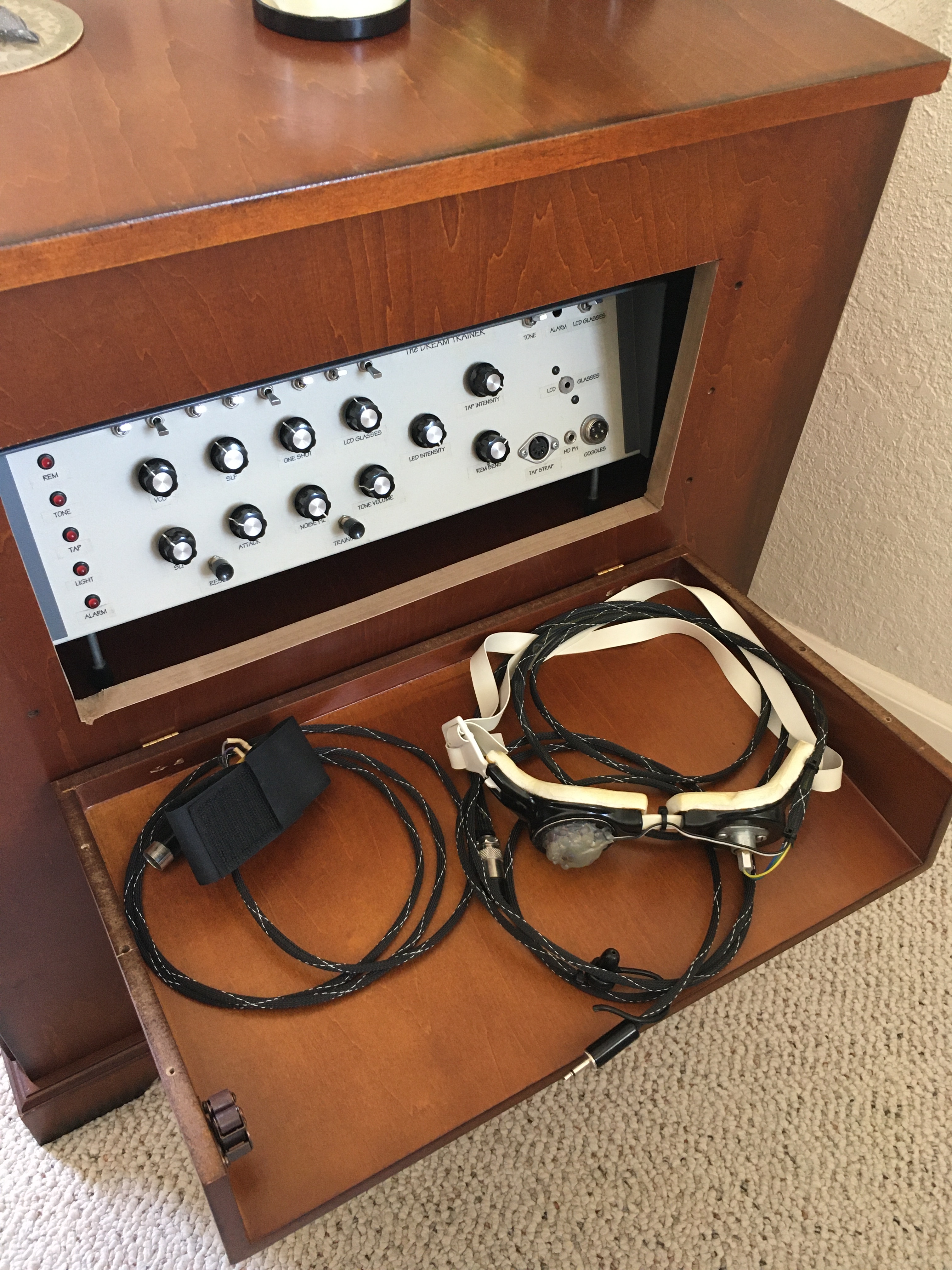
From Dreams, to Afterimages, to Therapeutic Lenses – A Personal Journey

The journey began while looking out a window, which was strongly back lit — I had an idea.  When I closed my eyes, I could still clearly see the images which appeared outside the window.  These were very strong “afterimages,” which made me think that it would be interesting to flash simple images over my eyelid while sleeping.

My thought was that simple images could be incorporated into my dream, triggering lucidity or alertness within the dream without awakening me, allowing me to explore the dream state.  I theorized that the image could also be used to set the theme of the dream.  In a sense, I wanted to designate the dream’s subject matter prior to sleeping.

This led me on a five-year project to develop my so called “Lucid Dream Trainer,” which incorporated REM or Rapid Eye Movement detection goggles connected to a box that once my dream state was detected, could send flashing red light to my eyelid, tones to my ears, and slight tactile stimulation to my wrist. (Lucid Dream Trainer and Pattern Disk Viewer: Can You Talk To Animals In Your Dreams?) I used the disk viewer to predetermine the dream’s subject matter.

After a bit of time getting use to wearing modified swim goggles to bed, the device worked pretty well, sending me on some interesting dream journeys, where I searched for ideas for music and for new inventions.

Several years later, still interested in afterimages, I had an idea for a vision test.  Through research, I learned that afterimages and the time that they remained visible, could be used to detect diabetes, a leading cause of blindness.

I proposed a simple instrument and study to the R&D group at the vision care company where I worked, but unfortunately it was determined that too much research was needed, and it was not pursued.

Later, I learned of a study that was done using afterimages to reduce pain resulting from injury.  Essentially, the afterimage was focused upon and after a period of training, the user was able to produce Alpha brain waves, which can reduce pain, lower blood pressure, relieve stress, and many other beneficial effects.

Having studied afterimages for several years, I was very intrigued and contacted the Australian psychologist who carried out the study – Dr. Brian Costello.  We became friends and exchanged emails and ideas over the next several years, until his unfortunate passing in 2010.

Brian’s study showed that if the user focused on a yellow-green image and then closed their eyes and focused on the resulting violet afterimage, they could produce Alpha brain waves.

I soon learned how to produce Alpha waves using Brian’s technique.  This set me off on a new journey, one of using Afterimages to improve health, athletic, and daily performances.

Alpha brain waves cause us to relax.  Normally, while awake, our brains are in a “Beta state.”  Meaning we are alert and processing data quickly.  Alpha waves, which are much slower, allow us to relax and perform at optimal states.  This is often referred to as being in “The Zone” by great athletes, who many times are on auto-pilot during their performance.  They are not aware or stressed; they just do it – perfectly.

I first developed a set of Alpha get well cards or “The Only Get Well Card That May Actually Make You Well,” and developed similar patented products for athletes and other performers to reduce stress, including a clothing line. (Alpha Golf Disk: AlphaWAVE Relaxation / Performance Improvement Disk.)

The only issue with these products is that it takes the user about two to four weeks, ten minutes a day to condition oneself to the Alpha state.  It works well, but some people will not hang in there that long.  We all want the results, but most want them quickly.

While working one day with a vision instrument, I noticed that the blue color of the Blue-Yellow feature on the device was very near the color of the afterimage, which becomes visible when one closes their eyes after focusing on the image of the Alpha Get Well card that I developed.

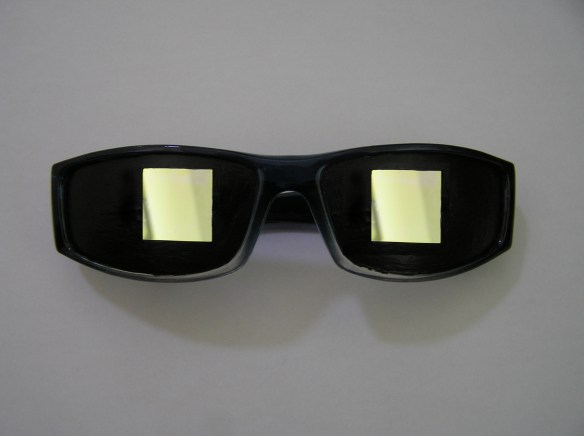
I measured the blue filter and found that it was really in the indigo part of the visible spectrum, but very close to Brian’s findings. So this got me thinking once again. What if I could apply that blue lens into a pair of blacked-out sun glasses?  My thought was that this would present only that wavelength of light directly to the eye, and using a simple training methodology, I could quickly induce Alpha waves.

I made a pair, and the results were amazing.  Alpha waves could be produced within a short training period.  I continued to experiment with the glasses thinking this might be a good product.  The Alpha glasses could be marketed to Clinical Psychologists as a stress and pain reducing tool, a therapeutic lens if you will. Alpha Glasses: Alpha Brainwave Generation Glasses.)

My new dream was that the Alpha glasses would be developed, and used to treat service veterans who experienced Post Traumatic Stress Disorder (PTSD), and others who suffer from trauma-related disorders.

The Alpha Glasses will hopefully come to market one day – for me, a dream come true.

Moral:  Pursue your dreams; you never know where the journey will take you!