
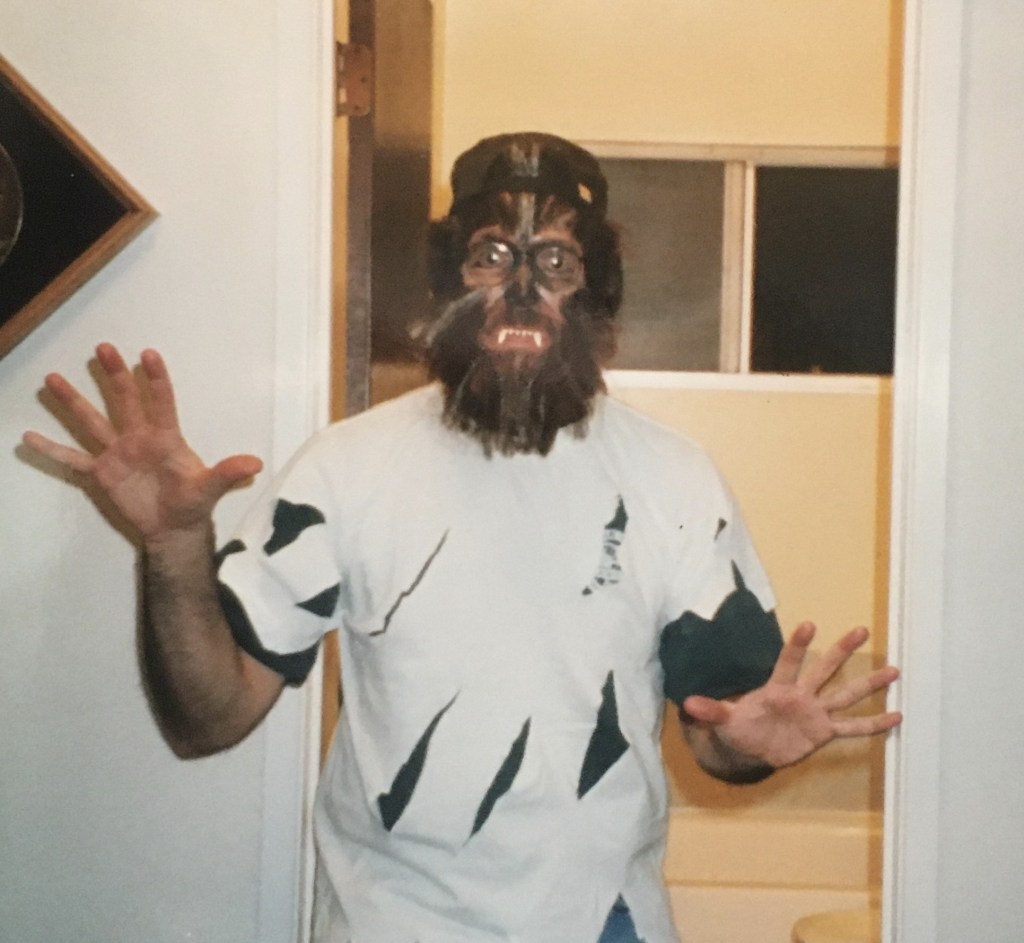
A werewolf is a mythical creature that shapeshifts from a human into a wolf-like animal. It is highly unlikely that this could ever happen, but during the magical season of Halloween, well, I believe anything is possible.

In the event that you do run into a werewolf, on a chilly, full moon night, I am going to share with you my acquired knowledge of wolf behavior. This will enable you to understand their intent, and indeed could save your life!
Signaling behavior is how Canis lupis or wolves (and I assume werewolves too) communicate with one another. Since Canis lupis familiaris or dogs are 99.9% genetically the same as a wolf, this applies to their communication behavior as well.
Wolves are very social animals, with structured hierarchical environments and social behavior, evolved for pack bonding and survival.
Signaling behaviors include:
- Auditory Signals;
- Olfactory Signals; and
- Visual Signals
Auditory Signals:
Vocalizations include: Howling, Barking, Whining, Yelping, Whispering, Growling, and various combinations of each.
- Howling – Is used to gather the pack, mark territory, and signal location to other wolves, telling rivals, this is my turf. Often used for long distance communication.
- Barking – Bark/Growl combinations serve as a warning, usually directed at intruders.
- Whines, Yelps, and Growls – Are often associated with distress, care behaviors, fear or submission, and threat.
The video below was taken in 2024 at the Oakland Zoo Gray Wolf habitat. It takes a moment to hear the howling, yelps and whines, so hang in there – it’s worth it! (Make sure that your sound level is up more than normal.)
Olfactory Signals:
All canids examine urine, feces, anal and genital areas, as well as the mouths and ear regions of other canids.
During a social greeting, a submissive animal will frequently uninate. Urination, can also be associated with fear, marking of unfamiliar objects, other animals, or sent posts (boundary lines), which may be respected by other canids.
Canids may also roll or rub in others urination and feces. This may actually be reinforcing for the specific animal, as it receives more social attention by other pack members.
Visual Signals:
Facial Expressions, Postures, and Body Markings, all play a significant role in determining aggression, dominance, and submission.
- Aggression – Tooth snapping, baring of teeth, ears flattened and erect, yelps and growls can all be exhibited at a distance. Maintaining a social distance (with these displays) helps to reduce actual physical aggression.
Warnings, the intention of biting, combines both visual and auditory signals, as a means to increase social distance, such as snapping in the air close to its challenger, but does not actually bite. In a threat, the wolf will bare its teeth, open mouth slightly, and hold the corners of its mouth tightly back.
In attack posture, the head is lowered, ears are moved so that the openings are sideways, and the tail is moved side to side slowly, wrinkling of the muzzle and mouth slightly agape.
In defense postures, the body is kept low, the back arched, head lowered, and muzzle raised. - Submission – Avoiding eye contact, wagging tail, lowering hind quarters, head and ears, and pull lips back horizontally into a grin. The animal my also raise one forepaw, twist its head to one side, twist its hind quarters, which are almost on the ground making a ‘C’ posture, and possibly crawl on it’s belly. It may also lick and nose towards one side of the superior animal’s mouth. Rolling over with its tail tucked between its legs, and possibly expose its genitalia.
- Body Markings and Coloring – The tail is used as a visual signal. When the tail is erect or arched, the wolf is aroused. When lowered, it is submissive and is wagged when greeting.
White tipped tails help to enhance the various tail positions and movements.
A white muzzle acts as contrast to black lips, and enhances the visual signal of the mouth.
Piloerection, or raising of the hair on the back of the animal, serves to enhance the visual displays.
If you encounter a werewolf on Halloween night or anytime, be sure to observe its signaling behavior, keep your social distance… then run like heck!
Note: Details for this post were primarily acquired from the following texts, and my university senior research paper in Animal Social Psychology – “Signaling Behavior Among Wolves.”
Fox, Michael W. – “Behaviour of Wolves, Dogs and Related Canids”
Scott, J.P. – “The Evolution of Social Behavior and Function in the Wolf and Dog”
 Mr. G's Mind