I think that most people have read stories about chimpanzees and gorillas who have been taught American Sign Language (ASL).
Scientists agree that they can learn ASL, but how much they actually understand is still debated. “The debate is not that they cannot learn to associate signing with objects and activities, but can they grasp grammar and actually use ASL to express ideas and thoughts.”
I do not know the answer to that debate, however, I can only tell you about one experience that I had with a chimpanzee and ASL.
A couple of years after completing college, I applied for a job at the University of Nevada, Reno. The position was for a Research Assistant (RA) to care for and interact with chimpanzees. Additionally, the RA would learn ASL, and then teach the young chimps what he/she had learned.
The program was headed up by two psychology professors: Dr Allen Gardner and Dr. Beatrix Gardner. The Gardner’s were the first to teach ASL to a young chimpanzee, who they named Washoe.
Basically, they adopted Washoe and raised her as they would their own child. Needless to say history was made, with Washoe becoming the first nonhuman to learn ASL. The Gardner’s research received acclaim worldwide!
I did not expect to ever hear anything back, but weeks later I received a letter inviting me to come to Reno for an interview. The interview was to last a weekend, where I would meet the Gardner’s, the other RA’s, and of course the young chimps!
I already had a decent job and apartment, but I figured this was something I had to do. So I flew to Reno, and hitched a ride to the university with some students that I had met on the flight.
It was wonderful meeting and talking with Dr. Allen Gardner during the interview. At that time, he was one of most famous psychologists working in animal communication. So this alone, was an honor for me.
After the interview, a student drove me out to the RA and chimpanzee living quarters. It was actually once a ‘divorce motel.’ These were hotels that were set up for out-of-state people who wanted to get a quick divorce, which was legal in Nevada.
My room was a standard hotel room. The young chimps, each had their own sleeping quarters, and a common playroom. RA’s would play, care for, teach ASL, and provide other interactions for the chimps everyday. Believe me, everything was about the chimps! Most all interactions provided opportunities to teach a new sign. However, young chimps, like young children are not always willing. I think you know what I mean.
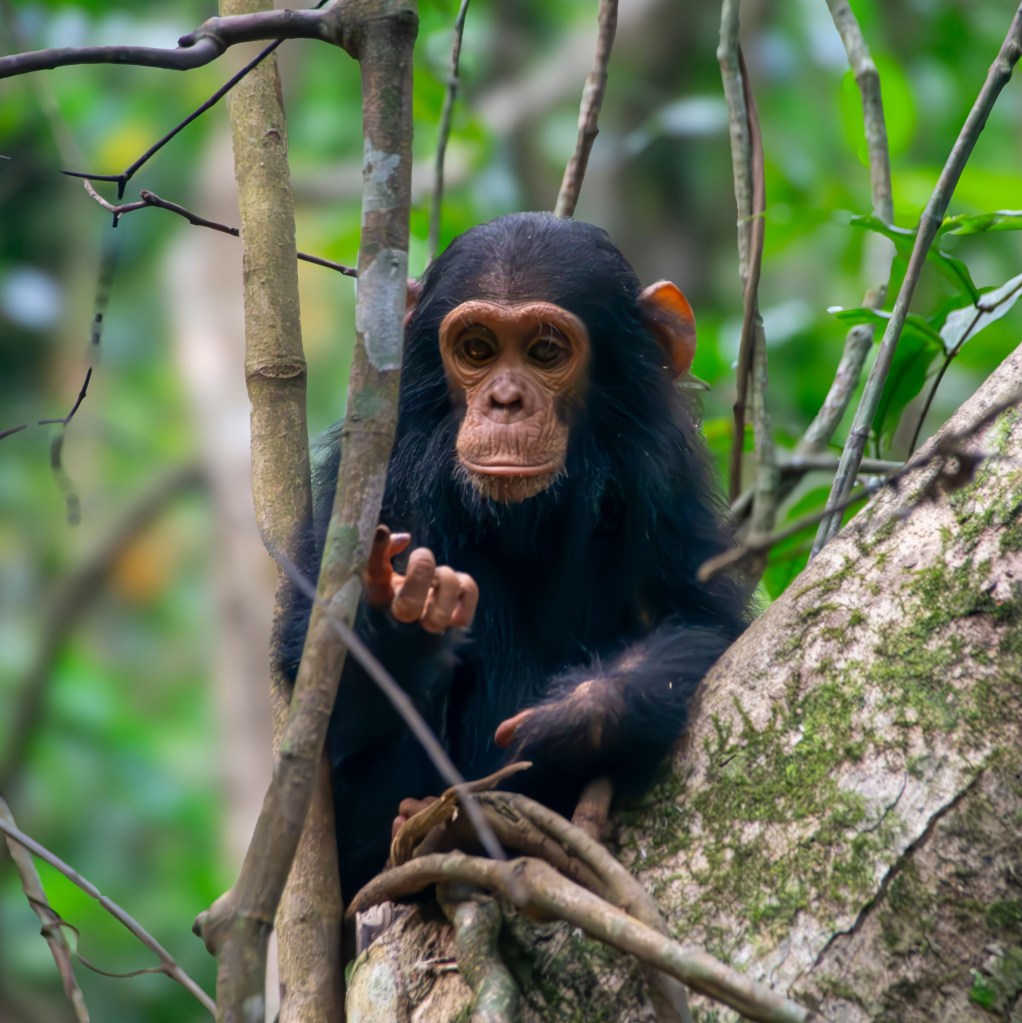
On Saturday morning, I met one of the RA’s. I was to spend a few hours with him and one of the chimps. The RA picked me up at my room, and then we went to ‘Dar’s’ sleeping quarters. When Dar spotted the RA, he became very excited. I could tell Dar knew an adventure was about to begin.
All three of us slowly walked down a little path to a seating area in a small wilderness area. The RA was holding Dar’s hand while I followed behind. Dar looked back several times to check out the new guy.
We sat down on some log seats and Dar and the RA made a few signs to each other. As I did not have any knowledge of ASL, I had no idea what they were saying. I felt like the “dumb” guy for sure.
From this point on, the RA vocalized what he was signing to Dar. Then the RA signed to Dar, “Want Pop Rocks?” Dar quickly signed back, “Yes.” Pop Rocks if you recall are little candies that “POP” in your month once eaten.
When the RA gave Dar a few Pop Rocks he quickly put them in his mouth. Oh My God, the look on Dar’s face was priceless. His eyes widened with delight and excitement! Dar asked, “Pop Rocks, more?” Then the RA taught me the signs for “Want Pop Rocks?” and “Yes.” I signed to Dar, “Want Pop Rocks?” Of course, Dar signed back, “Yes.” I gave him a few Pop Rocks, and well, we were communicating. It was an amazing feeling!
Then the RA taught me the sign for M&M’s. I signed to Dar, “Want M&M’s?” Of course Dar signed, “Yes.” Dar quickly put the M&M’s in his mouth. This time, he did not chew or swallow them. He took them out of his mouth and put them in his hand. Dar then signed to me, “Want M&M’s? I signed back, “Yes” and consumed them without hesitation. I really didn’t think much of it at the time. Dar then signed, “Want M&M’s” and I gave him a few more. This time he ate them.
The three of us practiced a few more signs until it was time to go back to the playroom, where Dar was given to another RA for more activities.
Understand that the treat rewards were not given all the time. The rewards and amounts varied based on whether a new sign was learned, how well it was executed, if the new sign was used in a new way, etc. Rewards were not always candy either. Sometimes rewards were things like fruit, play tickle, hide and seek, or a hug for example.
Later that day, I had another interview with Dr. Gardner. He had learned about my interactions with Dar. He said, “You know, it is pretty unusual for an animal to share its food with another animal (in this case me).” I took that as a sign that the interview went well.
Later that night I went to mixer event, and met all the other RA’s. It was a lot of fun talking and hearing their stories.
Sunday morning I went to the airport and flew home. A memorable weekend for sure!
The first time Washoe tasted watermelon, she did not yet know the sign for watermelon. On her own she signed, “Sweet” and “Water.” A perfect description!
I’ll let you decide if chimps can really understand and express ideas and thoughts using ASL.

